
Wood waste is generated from construction and demolition projects, furniture manufacturing, pallets, packaging, sawmills, forestry operations, and municipal waste collection. Instead of sending discarded wood to landfills, recycling plants can process it into reusable wood materials, biomass fuel, or RDF feedstock.
A complete wood recycling production line combines shredding, separation, screening, and material handling equipment. The exact configuration depends on the type of wood waste, contamination level, processing capacity, and final product requirements.
What Is a Wood Recycling Production Line?
A wood recycling production line is a series of machines designed to process waste wood into a smaller, cleaner, and more uniform material.
Typical feedstock includes:
Waste wood
Wooden pallets
Furniture waste
Construction wood
Demolition wood
Wood packaging
Branches and woody biomass
Depending on the application, the finished material may be used for biomass fuel, engineered wood products, mulch, or further recycling.
What Equipment Is Needed?
1. Feeding Conveyor
A feeding conveyor transports wood waste into the processing system at a consistent rate.
Stable feeding helps prevent overloads and improves the efficiency of the entire production line.
2. Primary Double Shaft Shredder
The double shaft shredder is usually the core size-reduction machine in a wood recycling line.
It uses two counter-rotating shafts with cutting blades to tear bulky wood into smaller pieces.
Key advantages include:
High torque
Strong tearing force
Suitable for bulky wood
Ability to handle mixed materials
Stable continuous operation
This makes it suitable for pallets, furniture, construction wood, and other irregular waste wood.
3. Magnetic Separator
Waste wood from construction, demolition, and furniture sources may contain nails, screws, hinges, and other ferrous metals.
A magnetic separator removes these metal contaminants after shredding, improving material quality and protecting downstream equipment.
4. Screening Machine
A screening machine separates shredded wood according to particle size.
Oversized material can be returned for further shredding, while appropriately sized material continues to the next stage.
5. Air Separation Equipment
For mixed or contaminated wood waste, an air separator can help separate lightweight materials such as plastic film and textiles from heavier wood particles.
This improves the purity of the recovered wood.
6. Secondary Shredder
Some applications require a smaller and more consistent final particle size. A secondary shredder can further process the material after primary shredding and separation.
Whether secondary shredding is required depends on the final application.
7. Conveying and Storage System
Discharge conveyors transport processed wood to storage areas, drying equipment, or subsequent production systems.
Storage equipment can also help maintain a continuous supply of processed biomass material.
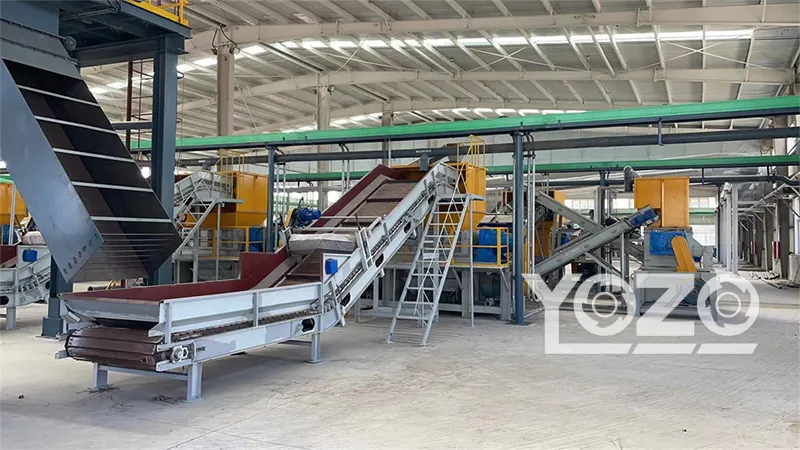
Typical Wood Recycling Process
A typical production line may follow this workflow:
Wood Waste Feeding → Primary Shredding → Magnetic Separation → Screening → Air Separation → Secondary Shredding → Final Product
Not every project requires all of these machines. A clean pallet recycling project, for example, may use a simpler system, while contaminated construction and demolition wood may require additional separation.
What Can Recycled Wood Be Used For?
After shredding and separation, the recovered wood can be used for different applications.
Biomass Fuel
Suitable wood waste can be processed into biomass fuel for industrial boilers, heating systems, and biomass power generation.
Engineered Wood Products
Clean wood fibers and particles can be used as raw materials for products such as particleboard and other engineered wood materials.
Mulch
Certain clean wood waste can be further processed into mulch for landscaping applications.
RDF Production
Mixed combustible wood waste can also be processed as part of an RDF production system after appropriate sorting.
How to Choose Equipment for a Wood Recycling Line?
The equipment configuration should be based on several factors.
Material Type
Pallets, furniture, branches, and demolition wood have different characteristics and may require different shredding configurations.
Contamination Level
Wood containing metal, plastic, soil, or other contaminants requires additional separation equipment.
Processing Capacity
Determine the required tons per hour and select equipment that can meet current production needs while allowing for future expansion.
Final Product
The required output size depends on whether the material will be used for biomass fuel, engineered wood products, mulch, or another application.
Why Choose YOZO Machinery?
As a professional manufacturer of industrial shredding and recycling equipment, YOZO Machinery provides customized solutions for wood waste recycling and biomass processing.
YOZO Machinery can provide:
Heavy-duty double shaft shredders
Wood waste shredding systems
Customized recycling production lines
Wear-resistant blade technology
Material separation solutions
Professional engineering support
Whether you need to process pallets, furniture waste, construction wood, or mixed wood waste, YOZO Machinery can design a system according to your feedstock, processing capacity, and final product requirements.
Conclusion
A complete wood recycling production line may include a feeding conveyor, double shaft shredder, magnetic separator, screening machine, air separator, secondary shredder, and conveying system.
The most suitable configuration depends on the type and condition of the wood waste and the desired final product. For bulky or mixed wood waste, a heavy-duty double shaft shredder provides an effective starting point for size reduction and downstream recycling.
With customized shredding equipment and complete processing solutions, YOZO Machinery helps wood recycling facilities improve processing efficiency, recover valuable resources, and reduce landfill disposal.