
Scrap tires are one of the most challenging waste materials to handle because of their strong rubber structure, steel reinforcement, and large volume. As the number of end-of-life tires continues to increase, efficient scrap tire processing has become increasingly important for recycling companies, waste management facilities, and tire recycling plants.
A tire shredder provides an effective first-stage solution by reducing whole tires into smaller, more manageable pieces. By improving material handling, reducing storage volume, and preparing tires for downstream separation and recycling, a tire shredder can significantly improve the efficiency of a scrap tire processing system.
What Is a Tire Shredder?
A tire shredder is an industrial shredding machine designed to process waste tires into smaller pieces. Depending on the processing requirements, it can handle passenger car tires, truck tires, bus tires, agricultural tires, and other types of used tires.
For primary tire processing, a heavy-duty double shaft shredder is commonly suitable because it uses two counter-rotating shafts equipped with cutting tools to grab, tear, and shear large tires.
Unlike conventional cutting equipment, a high-torque shredder can process bulky and tough materials continuously, making it suitable for the demanding conditions found in scrap tire recycling plants.
Why Is Scrap Tire Shredding Important?
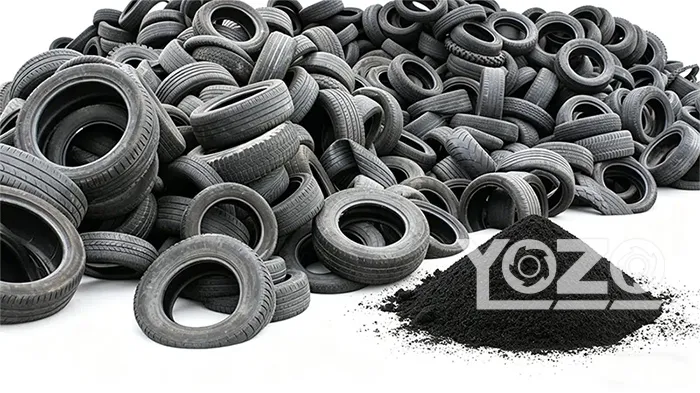
Whole tires are difficult to transport, store, and process efficiently. Their hollow structure also means that they occupy a considerable amount of storage space relative to their actual material weight.
Shredding helps solve these problems by:
Reducing the volume of whole tires
Making tires easier to convey and transport
Improving storage efficiency
Preparing tires for further separation
Increasing processing line capacity
Producing a more uniform feedstock for downstream equipment
Instead of sending whole tires directly into subsequent processing equipment, shredding creates a controlled intermediate material that is easier to handle.
How Does a Tire Shredder Improve Processing Efficiency?
1. Reduces the Size of Whole Tires
The primary function of a tire shredder is size reduction. Whole tires are transformed into smaller rubber-rich pieces that can be transported and processed more efficiently.
This is particularly important for large truck and bus tires, which can be difficult to handle manually or with conventional size-reduction equipment.
2. Improves Material Handling
Shredded tires are easier to move through conveyors, feeders, screens, and separators.
A well-designed shredding system can create a more consistent feedstock for the next stage of the recycling process. This helps reduce feeding problems and improves the overall flow of material through the plant.
3. Reduces Storage and Transportation Volume
Scrap tires can occupy significant storage space. After shredding, the material can be stacked and transported more efficiently.
For recycling companies handling large quantities of end-of-life tires, improved space utilization can reduce logistical challenges and make material management easier.
4. Prepares Tires for Steel Separation
Many tires contain steel reinforcement wires and belts. After primary shredding, downstream equipment such as magnetic separators can be used to recover ferrous metal from the shredded tire material.
A typical processing flow may include:
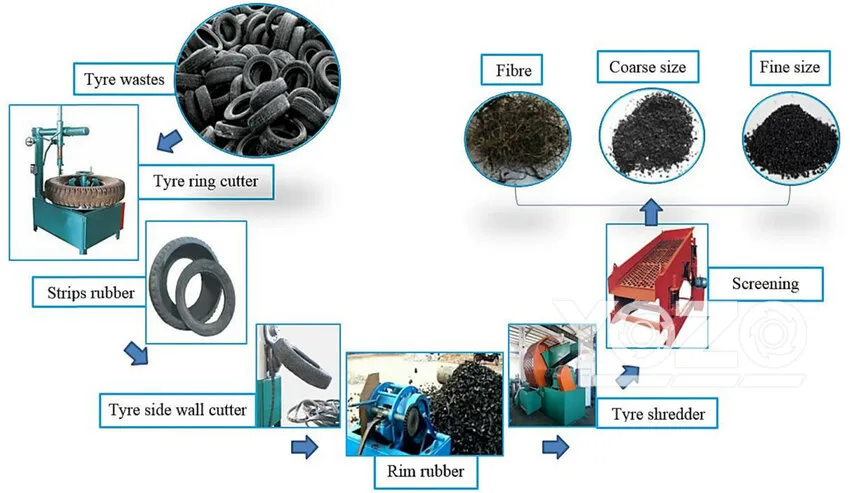
Whole Tires → Primary Shredding → Magnetic Separation → Screening → Secondary Processing → Rubber Products
The exact configuration depends on the required output size and final recycling application.
5. Supports Tire-Derived Fuel Production
Shredded tires can be used as a feedstock for Tire-Derived Fuel (TDF) applications when they meet the requirements of the intended fuel system.
For fuel-oriented processing, the shredder reduces whole tires into appropriately sized pieces that can be transported and fed into subsequent systems more efficiently.
The required particle size depends on the specific combustion or fuel application, so the complete system should be designed around the final product requirements.
Why Use a Double Shaft Shredder for Scrap Tires?
A double shaft shredder can be a practical choice for primary scrap tire processing because tires are tough, elastic, and resistant to conventional cutting.
Its two-shaft configuration provides strong grabbing and tearing action. The machine can continuously pull tires into the cutting chamber instead of relying only on impact or high-speed cutting.
Key advantages include:
High torque for difficult materials
Strong tearing and shearing capability
Suitable for bulky whole tires
Continuous feeding and processing
Reduced need for extensive pre-cutting
Flexible integration with conveyors and separators
For recycling plants processing mixed tire sizes, the ability to accept bulky feedstock can simplify the front end of the production line.
What Happens After Tire Shredding?
Shredding is usually only the first stage of a complete tire recycling process.
Depending on the final product, the shredded material may pass through several additional processing stages.
Tire-Derived Fuel
For TDF production, the process may focus on producing a relatively consistent tire-derived fuel feedstock.
Rubber Recycling
For higher-value rubber recovery, additional size reduction and separation may be required. Steel and fiber can be separated from the rubber fraction before further processing.
Steel Recovery
Magnetic separation equipment can recover steel from shredded tires. The recovered steel can then be collected and sent for metal recycling.
Rubber Granules and Powder
If the goal is to produce rubber granules or rubber powder, the shredded tires generally require additional grinding and refining equipment after primary shredding.
Therefore, the tire shredder should be selected as part of the complete processing system rather than as an isolated machine.
How to Choose a Tire Shredder?
The right tire shredder depends on several factors.
Tire Types
Determine whether the machine will process passenger tires, truck tires, agricultural tires, or a mixture of different tire types.
Required Capacity
Consider the required processing capacity in tons per hour. A recycling plant with continuous high-volume production will require a different configuration from a small-scale operation.
Desired Output Size
The required output size depends heavily on the next processing stage. Primary shredding and fine rubber grinding have very different requirements.
Material Composition
Tires contain rubber, steel, and textile components. The machine must be designed for the actual composition and condition of the incoming tires.
Complete Line Configuration
Consider how the shredder will work together with conveyors, magnetic separators, screens, and secondary shredders or grinders.
A complete system approach usually produces better results than selecting a shredder based only on its rated capacity.
Why Choose YOZO Machinery for Tire Shredding?
YOZO Machinery provides industrial shredding solutions for demanding waste-processing applications. For scrap tire recycling, a double shaft shredder can be used as a primary size-reduction machine to process whole and bulky waste tires.
YOZO Machinery can help customers evaluate the required shredding configuration based on tire type, processing capacity, target output size, and downstream recycling requirements.
For projects that require more than primary shredding, the shredder can also be integrated into a complete tire processing line with conveying, magnetic separation, screening, and secondary size-reduction equipment.
The goal is not simply to shred tires, but to create a stable and efficient material flow for the entire recycling process.
Conclusion
A tire shredder plays an important role in improving scrap tire processing by reducing whole tires into smaller pieces, improving material handling, reducing storage volume, and preparing the material for separation and further recycling.
For many primary tire shredding applications, a heavy-duty double shaft shredder offers the torque and tearing capability needed to handle tough and bulky waste tires.
Whether the final goal is Tire-Derived Fuel, rubber recycling, steel recovery, or further production of rubber granules and powder, selecting the right primary shredder is an important step toward building an efficient tire recycling system.
With the right equipment configuration, YOZO Machinery can provide a practical shredding solution for scrap tire recycling and help transform difficult end-of-life tires into a more manageable and valuable feedstock.