
Waste tires are difficult to process because they are large, elastic, and highly resistant to cutting. In addition to rubber, tires contain steel reinforcement and textile materials, making them much more demanding than many ordinary waste streams.
For this reason, double shaft shredders are widely considered a practical solution for the primary shredding stage of tire recycling. Their high torque, strong tearing force, and ability to handle bulky materials make them suitable for reducing whole scrap tires into smaller pieces before separation and further processing.
But why are double shaft shredders used for tire recycling, and what advantages do they provide?
What Is a Double Shaft Shredder?
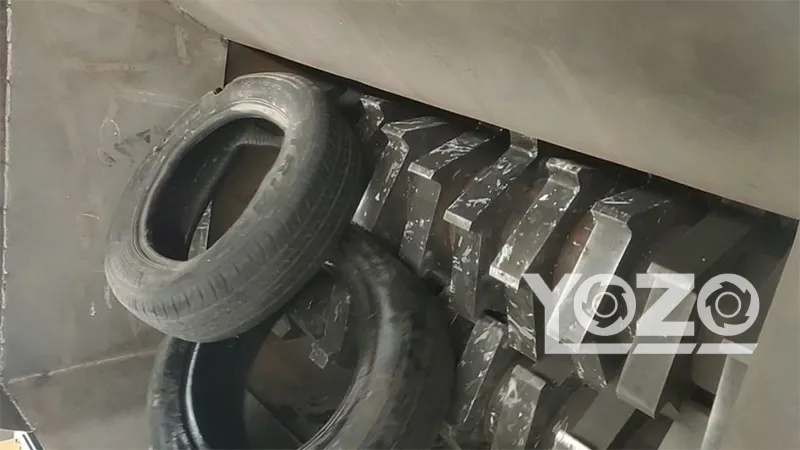
A double shaft shredder is an industrial size-reduction machine equipped with two counter-rotating shafts fitted with cutting blades.
As waste tires enter the shredding chamber, the shafts grab and pull the material between the cutting tools. The tires are then torn and sheared into smaller pieces.
This working principle is particularly useful for tires because their rubber structure is flexible and difficult to cut with conventional equipment.
A double shaft shredder is generally used for primary tire shredding, while additional equipment can be used afterward when smaller rubber particles or granules are required.
Why Are Tires Difficult to Shred?
Before looking at the advantages of double shaft shredders, it is important to understand the characteristics of scrap tires.
Waste tires typically contain:
Tough and elastic rubber
Steel wires and belts
Textile reinforcement
Thick sidewalls and tread sections
Different sizes and shapes
Passenger car tires are relatively manageable, while truck, bus, agricultural, and industrial tires can be significantly larger and heavier.
The elasticity of rubber can also make tires difficult to process with equipment designed primarily for rigid materials.
Therefore, tire recycling requires a machine capable of applying strong mechanical force consistently.
1. High Torque for Tough Tires
One of the main reasons double shaft shredders are used in tire recycling is their high-torque operation.
Instead of relying primarily on high-speed cutting or impact, the machine uses slow, powerful shaft rotation to grab and tear the tires.
This provides the force needed to process thick rubber and reinforced tire structures.
High torque is particularly valuable when processing:
Truck tires
Bus tires
Agricultural tires
Industrial tires
Mixed scrap tires
The machine can continuously pull difficult materials into the cutting chamber, helping maintain a stable shredding process.
2. Strong Tearing and Shearing Action
The two counter-rotating shafts create a strong tearing and shearing effect.
When a whole tire enters the chamber, the cutting tools engage with the rubber and gradually break it into smaller pieces.
This is different from simply cutting the tire into thin sections. The primary objective is to produce a manageable shredded feedstock for the next stage of processing.
The resulting tire chips can then be transported by conveyor systems and sent to separation or secondary size-reduction equipment.
3. Suitable for Whole and Bulky Tires
Another advantage is the ability to handle relatively large feedstock.
In many applications, whole scrap tires can be fed directly into a primary shredder without extensive manual cutting beforehand.
This can simplify the front-end process and reduce labor requirements.
For recycling facilities receiving mixed tire sizes, this flexibility can be especially useful because the incoming tires may vary considerably in diameter, width, and weight.
4. Reduces Tire Volume
Whole tires are difficult to store because their hollow structure takes up considerable space.
Shredding reduces the physical size and changes the shape of the material, allowing it to be stored and transported more efficiently.
This can provide several operational benefits:
Better use of storage space
Easier conveyor transportation
More efficient truck loading
Improved material handling
More consistent downstream feeding
For large-scale tire recycling plants, reducing the volume of incoming waste can make the overall material-handling system more efficient.
5. Prepares Tires for Steel Separation
Scrap tires contain a significant amount of steel reinforcement.
After primary shredding, the material can be passed through a magnetic separator to recover ferrous steel.
A typical processing flow may look like:
Whole Tires → Double Shaft Shredder → Magnetic Separator → Screening → Secondary Processing
The exact equipment configuration depends on the desired final product.
Recovering steel not only improves the quality of the rubber fraction but also creates an additional recyclable material stream.
6. Supports Tire-Derived Fuel Production
One important application for shredded tires is Tire-Derived Fuel (TDF).
Depending on the requirements of the end user, scrap tires can be shredded into appropriately sized tire-derived fuel feedstock.
A double shaft shredder can serve as the primary size-reduction machine in this process, reducing whole tires into manageable pieces before further processing.
The required particle size and processing configuration depend on the specific fuel application, so the complete system should be designed according to the customer's final product requirements.
7. Provides a Stable Feedstock for Further Processing
Primary shredding is often only the beginning of a tire recycling process.
If the goal is to produce rubber granules or rubber powder, the shredded tires may require additional processing.
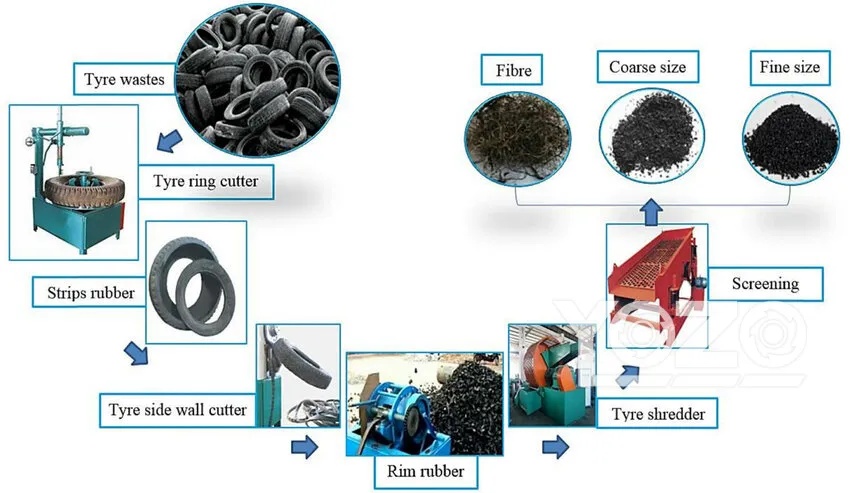
A typical recycling system may include:
Tire feeding system
Primary double shaft shredder
Magnetic separator
Screening equipment
Secondary shredder or grinder
Fiber separation
Rubber granulation or pulverization
Final screening and collection
The primary shredder plays an important role because it converts difficult whole tires into a more manageable feedstock for the equipment that follows.
Double Shaft Shredder vs. Other Tire Processing Equipment
Different machines serve different purposes in tire recycling.
A double shaft shredder is generally more suitable for primary size reduction of whole or bulky tires. It focuses on high torque and strong tearing rather than producing extremely fine particles.
By comparison, secondary shredders, granulators, and rubber pulverizers are better suited to producing smaller and more uniform rubber particles.
Therefore, a tire recycling plant may use several types of equipment rather than relying on a single machine for the entire process.
The correct choice depends on:
Tire type
Processing capacity
Desired output size
Final product
Steel and fiber separation requirements
Available downstream equipment
How to Choose a Double Shaft Shredder for Tire Recycling?
When selecting a shredder, several factors should be evaluated.
Tire Size
Consider whether the machine will process passenger tires only or also larger truck, bus, agricultural, and industrial tires.
Required Capacity
The required throughput determines the appropriate machine configuration and feeding system.
Target Output Size
Primary shredding usually produces larger tire chips, while smaller output sizes require additional processing stages.
Tire Composition
The amount of steel reinforcement and textile material can affect the processing requirements.
Complete Recycling Line
The shredder should be compatible with conveyors, magnetic separators, screens, and downstream grinding equipment.
Selecting the shredder as part of the complete production line helps ensure that the entire system operates efficiently.
Why Choose YOZO Machinery?
YOZO Machinery provides industrial shredding solutions for challenging waste materials, including scrap tires.
For tire recycling applications, a YOZO double shaft shredder can be used as the primary size-reduction equipment to process whole and bulky waste tires.
The machine can be integrated with conveyors, magnetic separation, screening, and secondary processing equipment to create a complete tire recycling system.
YOZO Machinery can also help customers evaluate the appropriate shredding configuration according to tire type, required capacity, target output size, and final recycling application.
The objective is not simply to reduce tire size, but to create a stable and efficient feedstock for the entire recycling process.
Conclusion
Double shaft shredders are used for tire recycling because they provide the combination of high torque, strong tearing force, bulky material handling capability, and continuous processing required for difficult scrap tires.
By reducing whole tires into smaller and more manageable pieces, they improve material handling and prepare the waste for steel separation, screening, Tire-Derived Fuel production, rubber granulation, or other downstream recycling processes.
For many tire recycling plants, a heavy-duty double shaft shredder is therefore an effective choice for the primary shredding stage.
With the right equipment configuration, YOZO Machinery can provide a reliable primary shredding solution for scrap tire recycling and help recycling companies build a more efficient tire processing line.