
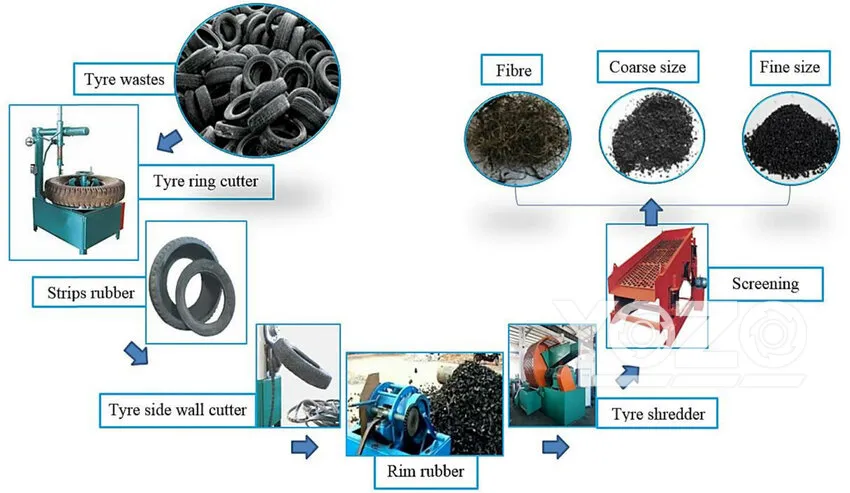
A modern tire recycling plant requires more than a single shredding machine. Waste tires contain rubber, steel, and textile materials, so an efficient recycling system needs several types of equipment to reduce tire size, separate different materials, and prepare the recovered products for further use.
The exact configuration depends on the final product. A plant producing Tire-Derived Fuel (TDF) may require a relatively simple shredding and separation system, while a plant producing rubber granules or rubber powder needs additional grinding and separation equipment.
So, what equipment is needed for a tire recycling plant?
What Is a Tire Recycling Plant?
A tire recycling plant is a processing system designed to convert end-of-life tires into useful materials such as:
Tire-derived fuel
Recovered rubber
Rubber granules
Rubber powder
Recovered steel
Textile fiber
The recycling process normally starts with primary shredding and continues through separation, screening, secondary size reduction, and final product processing.
A typical process can be summarized as:
Waste Tires → Primary Shredding → Steel Separation → Secondary Processing → Screening → Rubber Products
The equipment required depends on the desired output and production capacity.
1. Tire Feeding System
The first part of a tire recycling line is the feeding system.
Whole tires need to be delivered continuously and safely into the primary shredder. Depending on the plant design, this can be achieved using a loading system, hopper, conveyor, or other feeding equipment.
An efficient feeding system helps maintain a consistent material flow and prevents unnecessary interruptions to the shredding process.
For plants processing large quantities of tires, automated feeding can also reduce manual handling.
2. Primary Tire Shredder
The primary tire shredder is one of the most important machines in a tire recycling plant.
Whole tires are large, flexible, and reinforced with steel, making them difficult to process directly with conventional size-reduction equipment.
A heavy-duty double shaft shredder is commonly suitable for this stage.
Its two counter-rotating shafts provide strong grabbing, tearing, and shearing action. High torque allows the machine to process bulky tires and reduce them into smaller tire chips.
Primary shredding provides several benefits:
Reduces whole tire size
Improves material handling
Reduces storage volume
Creates a more consistent feedstock
Prepares tires for downstream separation
For many tire recycling plants, the double shaft shredder forms the foundation of the processing line.
3. Magnetic Separator
Scrap tires contain steel reinforcement, particularly in the tread and sidewall structures.
After primary shredding, a magnetic separator can be installed to recover ferrous steel from the shredded tire material.
The recovered steel can be collected separately and sent for metal recycling.
Magnetic separation also improves the quality of the remaining rubber-rich material, making it more suitable for subsequent processing.
A common configuration is:
Tire Shredder → Conveyor → Magnetic Separator → Rubber Processing
4. Screening Equipment
Screening machines separate shredded tire material according to particle size.
This is important because different applications require different output sizes.
For example, larger tire chips may be suitable for fuel applications, while rubber granules require much finer and more uniform particles.
Screening equipment can be used at different stages of the recycling process to control particle size and return oversized material for further processing.
5. Secondary Shredder or Grinder
If the final product requires smaller particles, a secondary size-reduction machine may be needed.
The primary shredder produces manageable tire chips, while secondary equipment further reduces their size.
Depending on the plant design, this stage may be used to produce:
Smaller tire chips
Rubber granules
Fine rubber particles
Feedstock for rubber powder production
The appropriate machine depends on the required final particle size and production capacity.
6. Fiber Separation Equipment
Waste tires also contain textile fibers.
When producing higher-quality recycled rubber, these fibers need to be separated from the rubber fraction.
Fiber separation equipment can be incorporated into the processing line after the tires have undergone sufficient size reduction.
Removing fiber helps improve the purity and quality of recovered rubber products.
The exact separation method depends on the tire composition and the specifications of the final product.
7. Rubber Granulation Equipment
Plants producing rubber granules require additional size-reduction equipment after primary shredding.
The shredded tire chips are gradually processed into smaller and more uniform rubber particles.
The granulation stage is important for applications such as:
Rubber flooring
Playground surfaces
Sports surfaces
Rubber products
Modified asphalt applications
The required particle size depends on the customer's application and product specifications.
8. Rubber Pulverizer
If the goal is to produce rubber powder, additional fine grinding equipment is required.
Rubber powder production involves considerably finer processing than primary tire shredding.
A typical process may include:
Whole Tires → Primary Shredder → Steel Separation → Secondary Processing → Fiber Separation → Fine Grinding → Rubber Powder
The finer the required powder, the more advanced the downstream grinding system needs to be.
9. Conveyor System
Conveyors connect the individual machines in a tire recycling plant.
They transport material between:
Feeding equipment
Primary shredders
Magnetic separators
Screens
Secondary shredders
Granulators
Fiber separation equipment
Final collection systems
A properly designed conveyor system helps maintain continuous material flow and reduces manual material handling.
The conveyor capacity should be matched with the processing capacity of the equipment it serves.
10. Product Collection System
The final stage of a tire recycling line requires suitable collection and storage equipment.
Depending on the plant configuration, separate collection systems may be required for:
Shredded tires
Recovered steel
Rubber granules
Rubber powder
Textile fiber
Efficient product collection makes packaging, storage, transportation, and further sale easier.
What Equipment Is Needed for Different Tire Recycling Products?
Not every tire recycling plant needs the same equipment.
Tire-Derived Fuel
A TDF-oriented plant may focus primarily on:
Feeding System → Primary Tire Shredder → Magnetic Separation → Screening → Finished Tire Chips
The required output size depends on the fuel application.
Rubber Granules
A rubber granule production line generally requires additional size reduction and separation:
Feeding → Primary Shredding → Steel Separation → Secondary Processing → Fiber Separation → Granulation → Screening
Rubber Powder
Rubber powder requires even finer processing:
Feeding → Primary Shredding → Steel Separation → Secondary Processing → Fiber Separation → Fine Grinding → Screening → Rubber Powder
Therefore, the final product should be determined before selecting the equipment.
How to Choose Equipment for a Tire Recycling Plant?
Several factors should be considered when designing a tire recycling line.
1. Type of Waste Tires
Determine whether the plant will process passenger car tires, truck tires, bus tires, agricultural tires, or mixed tire types.
2. Required Capacity
The expected amount of waste tires should be used to determine the capacity of the shredder, conveyors, separators, and downstream equipment.
3. Final Product
A TDF plant has different equipment requirements from a plant producing rubber granules or powder.
4. Target Output Size
The desired particle size determines how many stages of shredding, grinding, and screening are required.
5. Material Separation Requirements
If high-quality recycled rubber is required, steel and textile separation become important parts of the production line.
Why Choose YOZO Machinery for Tire Recycling?
YOZO Machinery provides industrial shredding equipment for demanding waste-processing applications.
For a tire recycling plant, YOZO's double shaft shredder can be used as the primary shredding machine to process whole and bulky waste tires.
The shredder can be integrated with conveyors, magnetic separators, screening systems, and secondary processing equipment to build a complete tire recycling line.
YOZO Machinery can also help customers determine a suitable shredding configuration according to the type of tires, required capacity, target output size, and final application.
The primary objective is to create a stable feedstock for the downstream recycling process while maintaining efficient and continuous material handling.
Conclusion
A complete tire recycling plant may include feeding equipment, a primary tire shredder, magnetic separators, screening machines, conveyors, secondary shredders or grinders, fiber separation equipment, granulators, and rubber pulverizers.
The required equipment depends largely on the final product. Tire-derived fuel production may require fewer processing stages, while rubber granule and rubber powder production requires additional separation and fine size reduction.
For the primary shredding stage, a heavy-duty double shaft shredder is a practical choice for many scrap tire recycling applications because it can handle large and tough tires while providing strong size-reduction performance.
With the right combination of equipment, YOZO Machinery can provide the primary shredding solution needed to build an efficient and scalable waste tire recycling line.